
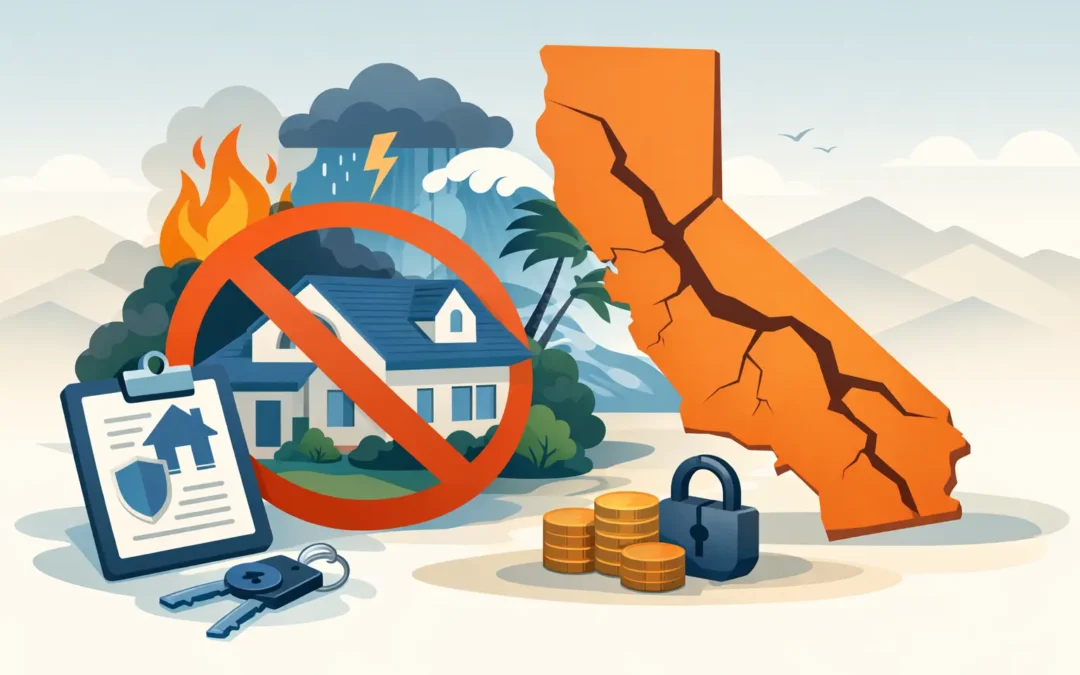
A lot of homeowners ask the same question right after a non-renewal notice lands in the mailbox or a lender asks for proof of coverage before closing: why is home insurance unavailable when you have never filed a major claim and have taken care of your property?
In much of Central and Northern California, the answer is not personal. It is market-driven. Insurance companies are making broad decisions based on wildfire exposure, rebuilding costs, and how much risk they believe they can carry in a specific region. That can leave responsible homeowners in the foothills and mountain communities feeling like they are being judged by their ZIP code instead of their individual home.
Why is home insurance unavailable for some homeowners?
When insurance becomes hard to find, it usually comes down to one issue: the carrier believes the chance of a large loss is too high compared with the premium it can charge. In California, that problem has become more severe because wildfire losses have been enormous, and insurers have become much more selective about where they write policies.
A home can be well maintained, owner occupied, and claims-free, yet still be declined. That surprises many people. But insurers do not only underwrite the house itself. They also underwrite the surrounding area, evacuation challenges, vegetation density, fire history, and the cost of replacing the home after a catastrophe.
For homeowners in the Sierra foothills, wooded subdivisions, or rural roads with limited access, availability often shrinks first and prices rise second.
The biggest reasons carriers stop offering coverage
Wildfire risk is the factor people know best, but it is not the only one. Insurers look at a combination of conditions, and several of them can stack up quickly.
Wildfire models are changing underwriting
Insurance companies use risk models to estimate the likelihood and severity of future losses. Those models now weigh wildfire far more heavily than they did a decade ago. A property near heavy brush, steep terrain, or areas with frequent red flag warnings may score poorly even if it has never been damaged.
This is one reason two homes in the same town can get different results. One may have better road access, more defensible space, or a lower modeled hazard score. The other may be flagged as more difficult to protect or rebuild.
Rebuilding costs are much higher
Even when the home value seems reasonable, the replacement cost may be much higher than expected. Labor shortages, material costs, permit requirements, debris removal, and code upgrades all affect what it would take to rebuild after a loss.
For insurers, that means one wildfire can create a cluster of very expensive claims at once. If they believe the premium does not match that exposure, they may pause new business or reduce the number of homes they insure in the area.
Carrier concentration limits matter
Sometimes a company is still writing insurance in California, but not in your neighborhood. That is because many carriers limit how much exposure they want in a single county, community, or wildfire corridor. If they already insure too many homes in one concentration zone, they may stop accepting more even if your property is otherwise acceptable.
This can be frustrating because it feels arbitrary from the homeowner side. But from the carrier’s perspective, it is about not taking on too many homes that could be affected by one major event.
Home condition still plays a role
Wildfire risk gets most of the attention, but basic underwriting still matters. Older roofs, deferred maintenance, aging electrical systems, wood shake roofing, overhanging trees, and poor access for emergency vehicles can all make a home harder to insure.
This is where the answer to why is home insurance unavailable can be partly local and partly property-specific. A carrier might already be cautious about the area, and then a roof near the end of its life becomes the factor that pushes the application into a decline.
Why California homeowners are feeling it more sharply
California’s insurance market has been under pressure for years. Large catastrophe losses, inflation in construction costs, and regulatory limits on rate changes have all affected how insurers operate here. Some companies have limited new policies. Others have issued non-renewals or narrowed the types of homes they are willing to cover.
For homeowners, the result is simple but painful: fewer standard market options, more underwriting scrutiny, and steeper premiums when coverage is available.
This is especially true in foothill and mountain regions where wildfire is not treated as a remote possibility. It is treated as an active underwriting concern.
When home insurance is unavailable, it does not always mean impossible
Unavailable does not always mean no one will insure the property. More often, it means the standard carriers you expected to quote the home are no longer the best fit.
That is an important distinction. Many homeowners assume a decline from one or two familiar companies means they have run out of options. In reality, high-risk properties often require a different path, including specialty carriers, surplus lines markets, or a FAIR Plan-based solution with companion coverage.
The key is understanding that these options are not all built the same. Price matters, but so do coverage gaps, deductibles, exclusions, and whether the policy actually protects the structure and your financial position the way you expect.
What to check before assuming no coverage is available
Before giving up, it helps to look at the reasons behind the decline. Sometimes there are practical fixes that improve insurability.
Start with the roof. Its age and material can have a major impact on underwriting. Then look at vegetation clearance, tree limbs near the house, visible maintenance issues, and property access. If the insurer sees a combination of high wildfire exposure and preventable condition problems, approval becomes much harder.
It also helps to review the replacement cost estimate. Some homes are underinsured on paper, while others are being quoted at rebuilding amounts that need a closer look. Getting that number right can affect both premium and placement options.
Documentation can make a difference
Photos of defensible space work, receipts for roof replacement, inspection reports, and updates to electrical or plumbing systems may support a better underwriting review. Not every carrier will reconsider based on documentation, but some will.
That is one reason working with a broker who knows wildfire-prone California markets can save time. The issue is not just finding a quote. It is presenting the home accurately to the right carriers.
The FAIR Plan question homeowners keep asking
When standard insurance becomes scarce, many homeowners hear about the California FAIR Plan. It can be an important option, but it should be understood clearly.
The FAIR Plan is not the same as a traditional comprehensive homeowners policy. It is designed as a basic fire insurance solution for properties that cannot obtain coverage in the standard market. In many cases, homeowners also need a separate companion policy to cover liability, theft, water damage, and other important protections.
That is where confusion can become costly. A homeowner may feel relieved to have found something, only to discover later that the coverage is incomplete. The better approach is to treat the FAIR Plan as one possible piece of the solution, not automatically the full answer.
How homeowners can improve their options
There is no magic fix, and honesty matters here. Some homes will remain challenging because of location alone. Still, there are steps that can improve the range of choices.
Reducing brush, maintaining strong defensible space, upgrading roofing materials, addressing visible maintenance issues, and documenting improvements can all help. So can shopping earlier instead of waiting until a policy is about to lapse. The closer you get to a cancellation or closing date, the fewer good choices tend to remain.
It also helps to compare more than just premium. A lower-cost quote with limited protection can create bigger problems after a loss. In wildfire country, details matter.
Why local guidance matters in high-risk areas
A homeowner in a suburban low-risk neighborhood may be able to shop online and get a quick answer. In foothill and mountain communities, it often takes a more hands-on approach.
That is because the real question is not just why is home insurance unavailable. It is which markets are still writing, what they require, and how to build coverage that does not leave dangerous gaps. A local specialist understands which carriers are active, where underwriting has tightened, and how to structure options when standard insurance falls short.
For many California homeowners, that guidance is the difference between feeling boxed in and finding a workable plan. Foothill Fire Insurance works with homeowners facing exactly this problem in high-risk areas, helping them compare available options and understand what each one actually covers.
If insurance feels unavailable right now, do not assume the door is closed. It may just mean the path is narrower, more specialized, and more important to get right than ever before. The right next step is to look at the real reason for the decline and build from there.