
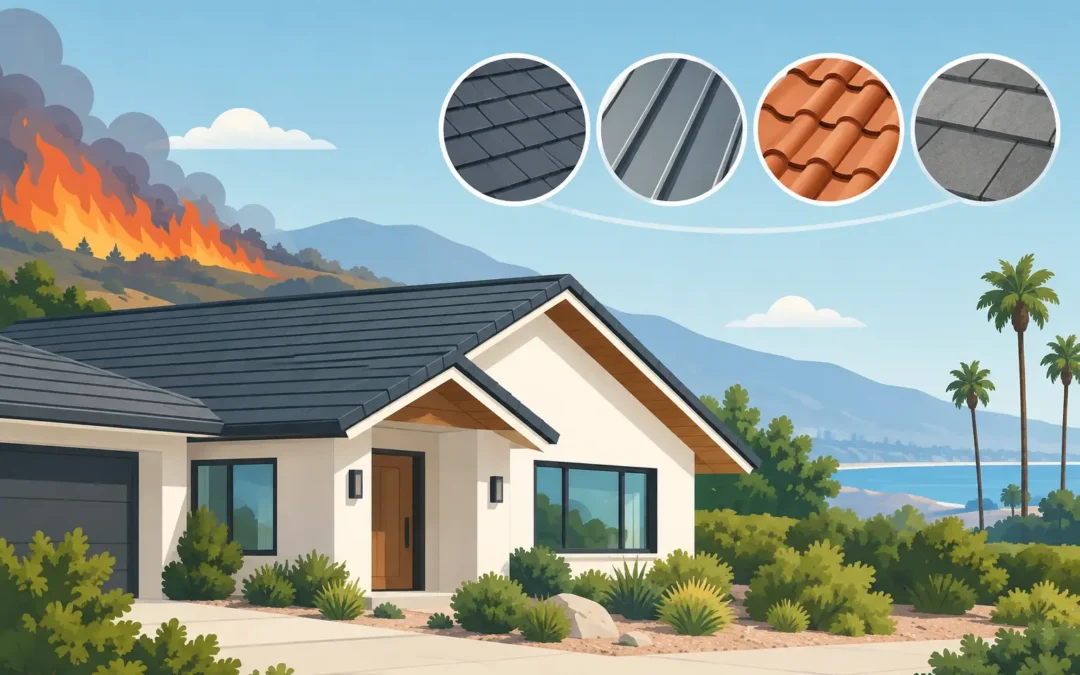
A wind-driven ember can travel well ahead of a wildfire, land on a roof, and turn a small vulnerability into a major claim. For homeowners in the Sierra foothills, mountain communities, and other high-risk parts of Central and Northern California, fire resistant roof materials are not simply a remodeling choice. They are a practical part of protecting the home, preserving insurability, and reducing the financial consequences of a wildfire.
A new roof alone will not make a property fireproof. Wildfire loss often involves multiple exposures, including dry vegetation, open vents, combustible decks, and debris-filled gutters. Still, the roof is one of the most important places to start because it covers the largest surface of the home and receives direct ember exposure.
Why Fire Resistant Roof Materials Matter in Wildfire Country
Wildfires do not have to reach a house with a wall of flames to cause a loss. Flying embers can enter a vulnerable attic vent, collect in roof valleys, or ignite dry leaves caught behind a chimney. A roof with a strong fire classification is designed to resist ignition from these exposures far better than an untreated combustible roof covering.
For many California homeowners, the issue is also connected to insurance. Carriers reviewing homes in wildfire-prone ZIP codes may consider roof type, condition, age, and debris, along with the surrounding vegetation and access for fire response. A Class A roof can be a meaningful positive feature during underwriting, particularly when combined with documented home-hardening work.
That does not mean a Class A roof guarantees a lower premium, a new policy, or a renewal. Each insurer uses its own guidelines, and wildfire eligibility depends on the entire property and location. But an aging combustible roof or a roof in poor condition can make an already difficult insurance search more challenging.
Understanding Class A Roof Ratings
When comparing roofing choices, homeowners will often see Class A, Class B, or Class C fire ratings. Class A is the highest classification and offers the greatest tested resistance to severe fire exposure. In wildfire areas, it is generally the standard homeowners should discuss with a qualified roofing professional.
The detail that matters is that the rating applies to a roofing assembly, not always the visible material by itself. The roof deck, underlayment, installation method, and specific product can all affect the final rating. A material marketed as fire resistant may not deliver the same protection in every assembly.
Ask the roofer to provide written confirmation of the roof’s Class A classification for the proposed installation. Keep the contract, permits, product specifications, final invoice, and photos after installation. Those records can be useful when updating your insurance broker or responding to an underwriting question.
Fire resistant does not mean fireproof
Even the best-rated roof has limits. Embers can still gather in gutters, behind skylights, and in roof-to-wall intersections. Flames can also reach the structure through nearby vegetation, fencing, wood piles, or an attached deck.
The goal is to reduce the number of ways a fire can gain a foothold. Roofing is one layer of a larger defensible-space and home-hardening plan.
Common Fire Resistant Roofing Options
The right roof depends on budget, architectural style, snow load, maintenance expectations, and local installation requirements. These are the materials California homeowners most often consider.
Metal roofing
Metal roofs are noncombustible and can achieve a Class A rating when installed as a tested assembly. They are popular in foothill and mountain settings because they are durable, shed debris well, and can complement both rural and modern home styles.
The trade-off is cost. Metal often has a higher upfront price than standard asphalt shingles, and proper installation is critical. Open gaps, poorly detailed edges, or accumulated debris in valleys can weaken the practical wildfire benefit. A metal roof still needs regular inspection and cleaning.
Concrete and clay tile
Concrete and clay tiles are noncombustible and commonly available with Class A fire ratings. They can offer long service life and work well on many California homes.
However, tile roofs are heavy. The structure may need to support the added load, and broken or displaced tiles should be repaired promptly. Debris can also accumulate beneath or between tiles, so maintenance matters more than many homeowners expect.
Fiberglass asphalt shingles
Fiberglass asphalt shingles are widely used because they are generally more affordable and available in Class A-rated systems. For homeowners replacing an older roof on a budget, a quality Class A fiberglass shingle can be a practical improvement.
Not every asphalt shingle is equal. Confirm the rating for the complete proposed roof system, and pay attention to wind rating, warranty terms, and installation quality. In areas with heavy pine needles or oak leaves, regular roof and gutter cleaning remains essential.
Slate and synthetic slate
Natural slate is noncombustible, long-lasting, and can provide excellent fire resistance. Its cost and weight, however, place it outside the practical range for many homeowners. Synthetic slate products may offer a lighter appearance-based alternative, but fire performance varies by manufacturer and assembly.
If you are considering a specialty product, do not rely on appearance or marketing language alone. Request the tested fire classification and make sure the installer has experience with the system.
Materials and Conditions That Raise Concerns
Untreated wood shake or shingle roofs are a serious concern in wildfire-prone areas. They can ignite from embers and may limit insurance options, especially when the roof is older or surrounded by dense vegetation. Some treated wood products have fire ratings, but homeowners should verify the current condition, treatment requirements, and insurer acceptance before assuming they will be treated like a noncombustible roof.
Roof condition matters even when the material is Class A. Missing shingles, cracked tiles, rusted flashing, moss, sagging sections, and heavy organic debris can all raise underwriting questions. A carrier may ask for inspections or photos, and a roof near the end of its expected life can become an issue during a policy application or renewal.
Make the Roof Part of a Home-Hardening Plan
A fire-resistant roof works best when the areas around it are addressed at the same time. Clean leaves, pine needles, and branches from gutters, valleys, and roof edges. Keep tree limbs from overhanging the roof, and repair damaged flashing or loose coverings before fire season.
Pay close attention to attic and crawl-space vents. Ember-resistant vents or properly designed vent protection can help reduce the chance of embers entering the home. Noncombustible gutters, protected eaves, screened chimney openings, and a well-maintained defensible space can further reduce exposure.
For homeowners planning a roof replacement, it can be more cost-effective to coordinate these improvements with the roofing project. Ask your contractor which details can be addressed while the roof is open, rather than treating each vulnerability as a separate emergency later.
What to Tell Your Insurance Broker After a Roof Upgrade
Once the work is complete, do not assume your insurer will automatically know about it. Send your broker the completion date, roof material, Class A documentation, invoice, permits if applicable, and clear photos. If you have completed vegetation management, vent upgrades, or other home-hardening work, document those as well.
These details may help a broker present your home accurately to available carriers. They can also be useful if you are comparing a traditional policy with the California FAIR Plan and a separate companion policy. The FAIR Plan may be part of the solution for some high-risk properties, but homeowners should understand where coverage limits, deductibles, and potential gaps may remain.
A roof upgrade is a meaningful investment, so it deserves an insurance review that looks beyond the price of a single policy. Ask whether your dwelling limit still reflects current rebuilding costs and whether your deductible would be manageable after a wildfire loss.
Before choosing a roof, get written Class A documentation, understand maintenance needs, and consider how the project fits into your broader wildfire protection plan. A complimentary insurance estimate can then help you see how those improvements fit into the coverage choices still available for your home.