
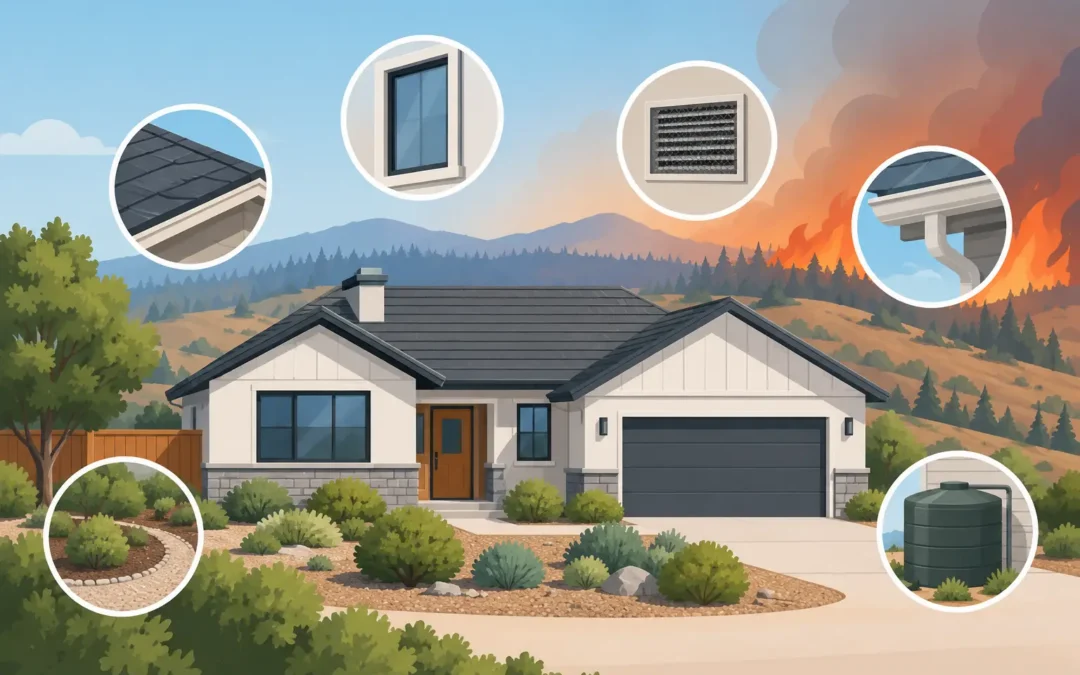
A wildfire does not have to reach a home as a wall of flame to cause a loss. In many California fires, wind-driven embers travel well ahead of the fire front, landing in dry leaves, open vents, wood fencing, or debris under a deck. That is why the best wildfire mitigation upgrades focus first on the small vulnerabilities that allow embers to turn into a structure fire.
For homeowners in the Sierra foothills, mountain communities, and rural parts of Central and Northern California, these improvements can do more than reduce fire exposure. They can help preserve a home’s insurability, support a stronger insurance application, and give an insurer a clearer picture of the steps taken to manage risk. No upgrade guarantees coverage or a lower premium, but documented mitigation can matter when insurance choices are limited.
Start With the Roof and Gutters
Your roof is one of the most consequential parts of your wildfire defense. A Class A fire-rated roof, such as composition shingles, tile, metal, or certain treated materials, offers far more resistance to fire than an older untreated wood shake roof. If roof replacement is already on your horizon, selecting a Class A assembly is usually one of the most meaningful long-term improvements a homeowner can make.
Gutters deserve equal attention because they collect the exact fuel embers need: dry leaves, pine needles, and small twigs. Keep gutters clean throughout fire season, especially after wind events. Metal gutter guards may help reduce buildup, but they are not a substitute for maintenance. Fine debris can still collect on top of guards and in roof valleys.
Also look at the roof-to-wall connection, skylights, and chimney areas. Leaves often gather in these transition points. A clean roofline may sound basic, but it addresses a common and preventable ignition path.
Upgrade Vents to Block Embers
Attic, crawlspace, and foundation vents are necessary for many homes, yet standard vent openings can let embers enter during a wildfire. Once inside, embers can ignite insulation, stored materials, framing dust, or debris that has accumulated over time.
Ember-resistant vents are among the best wildfire mitigation upgrades because they address this hidden entry point directly. Depending on the product and home design, these vents use fine noncombustible mesh, baffles, or intumescent materials that react to heat. The right choice depends on ventilation requirements, local building rules, and the existing design of the home.
Do not simply cover every vent with improvised material. Restricting airflow can create moisture, heat, and building-performance problems. A qualified contractor can help identify compliant vent solutions for the attic, eaves, crawlspace, and attached garage.
Create Defensible Space That Is Actually Defensible
Defensible space is not a single cleanup day before summer. It is an ongoing approach to managing vegetation, combustible materials, and access around the home. The goal is to reduce fuel close to the structure and limit the ability of fire to climb from grass to shrubs, shrubs to trees, and trees to the roof.
The area immediately around the home matters most. Remove dry leaves, pine needles, firewood, spare lumber, propane cylinders, outdoor cushions, and other combustible items from beside the structure. Keep plants irrigated, maintained, and separated where practical. Avoid allowing dense shrubs or low tree branches to touch the house, deck, fence, or roof.
Beyond that immediate area, spacing and maintenance become more site-specific. A steep wooded parcel needs a different strategy than a level suburban lot. Slope, prevailing wind, vegetation type, neighboring properties, road access, and water availability all affect the plan. Follow local defensible-space requirements and consult a qualified vegetation or fire-safety professional for complex properties.
Replace Combustible Details Near the House
Some of the highest-value changes are small construction details that homeowners overlook until an inspection or loss exposes them. Wood fencing that connects directly to the house can act as a wick, carrying flames to the siding. Consider replacing the section nearest the structure with metal or another noncombustible material, or create a noncombustible break between the fence and home.
Decks also need a close look. Clear all debris beneath and between deck boards. Enclose open under-deck areas when appropriate with noncombustible materials, and avoid storing anything combustible underneath. If a deck needs replacement, ask about ignition-resistant decking and noncombustible framing details.
Siding and trim deserve attention as well. Fiber-cement, stucco, masonry, and other noncombustible or ignition-resistant materials generally perform better than untreated wood in high-exposure areas. Full replacement can be expensive, so prioritize the lower portions of walls, corners, transitions, and areas where vegetation or fencing sits close to the house.
Improve Windows, Doors, and Eaves
Windows can fail under intense radiant heat, especially if they are older, single-pane units. Dual-pane tempered glass is more resistant to heat stress and breakage than standard single-pane glass. Replacing every window at once may not be realistic, but upgrading windows facing heavy vegetation, open canyons, or prevailing wind can be a sensible phased project.
Keep combustible window coverings away from glass during fire conditions, and maintain clear space around windows. Exterior shutters or screens may help in certain installations, but only if they are designed for wildfire exposure and do not introduce new combustible materials.
Open eaves and soffits are another ember-catching area. Boxed-in eaves, noncombustible soffit materials, and properly protected openings can reduce exposure. These upgrades are especially worth considering during a reroof, siding project, or major exterior renovation, when labor and material costs can be coordinated.
Do Not Forget Access, Addressing, and Water
Wildfire mitigation includes the practical details that help firefighters reach and identify a home. Keep driveways passable, trim branches that limit vehicle clearance, and make sure the house number is visible from the road in day and night conditions. For rural properties, confirm that gates can be opened quickly and that access roads are not blocked by overgrown vegetation or parked equipment.
A maintained pool, water tank, hydrant, or other water source may be useful in some locations, but it is not a substitute for home hardening and defensible space. Water availability, equipment compatibility, and firefighter access vary widely. Treat it as one part of a larger property plan, not as a standalone solution.
Document Your Work for Insurance Reviews
After making improvements, take clear, dated photos. Capture the roof, gutters, vents, cleared zones around the home, deck area, siding, driveway, and visible address. Save contractor invoices, material specifications, permits, inspection reports, and any local compliance documentation.
This record can be valuable when an insurer asks for updated property information or conducts a review. It also helps a broker present the property accurately when seeking quotes. A carrier may still consider broader factors such as the property’s location, claims history, roof age, surrounding wildfire exposure, and its own underwriting capacity. Mitigation is a meaningful part of the picture, not a promise of acceptance.
Homeowners using the California FAIR Plan should be especially careful about understanding what their policy does and does not cover. The FAIR Plan is often a necessary option for fire coverage, but it may need to be paired with a separate policy for liability, water damage, theft, and other protections. As you improve the property, it is a good time to review dwelling limits, deductibles, replacement cost assumptions, and any coverage gaps.
Choose Upgrades Based on Your Home’s Real Exposure
There is no single best project for every foothill or mountain home. A home with an aging wood-shake roof has a different priority than a newer home surrounded by dense brush and open eaves. If budget is limited, start with maintenance and ember vulnerabilities: clear debris, create space near the home, address vents, and remove combustible materials from decks and walls. Then plan larger capital projects such as roofing, windows, siding, or deck replacement around their normal replacement cycles.
At Foothill Fire Insurance, we see how closely property condition and insurance choices can intersect in high-risk California communities. Before renewing, purchasing, or changing a policy, gather your mitigation records and request a complimentary estimate with coverage and deductible options that fit your situation.
The most useful wildfire plan is the one you maintain. A cleaner roof, protected vent, trimmed branch, and well-documented improvement can each make a practical difference when fire season arrives.